
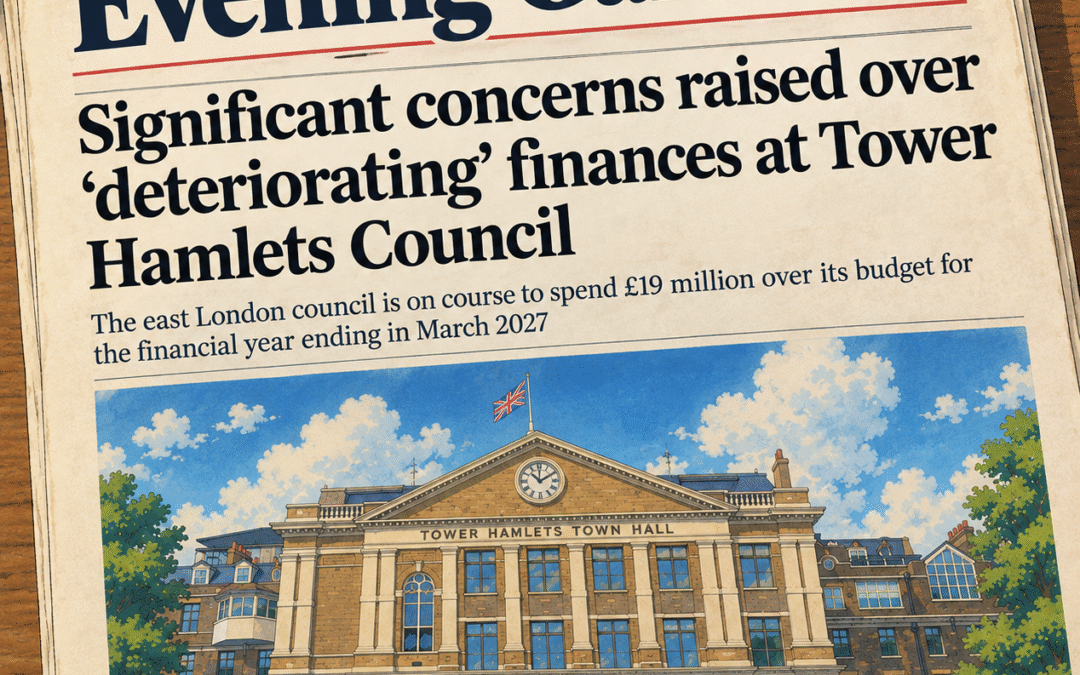
Tower Hamlets Council has avoided the emergency borrowing that props up nine London councils. But its auditors are now worried.
The Auditors’ Warning
This week, EY, Tower Hamlets Council’s auditors, said they had significant concerns about the council’s worsening finances.
The council expects to overspend by £19.2m this year, after overspending by £19.4m last year. Most of the extra money goes on adult and children’s social care and temporary housing for homeless families. The law requires councils to provide these services, and demand for them is rising across London.
EY questioned whether the council’s budget assumptions were realistic. The overspending is also using up the council’s savings. Its unrestricted reserves, the money it can spend on anything, fell from £55.5m to £40.5m in the year to March. Its total reserves fell by more than £50m. The council plans to put £20m into a reserve for emergencies this year, but EY pointed out that the plan ignores the expected overspend.
Not Yet a Bailout Council
Compared with much of London, though, Tower Hamlets is doing well.
Nine London councils need emergency help from the government this year. The scheme, called Exceptional Financial Support, lets councils in serious difficulty borrow money or sell assets to pay for everyday services. Without it, they would, in effect, go bust. The government has agreed to let them borrow these amounts this year:
| Council | Emergency support, 2026-27 |
|---|---|
| Croydon | £119.0m |
| Haringey | £84.0m |
| Barnet | £79.6m |
| Havering | £77.0m |
| Redbridge | £70.0m |
| Hillingdon | £62.0m |
| Lambeth | £20.0m |
| Waltham Forest | £19.0m |
| City of London | £2.65m (council housing only) |
Source: Ministry of Housing, Communities and Local Government, Exceptional Financial Support for local authorities for 2026-27 (last updated 18 August 2026). All amounts are agreed in principle.
Tower Hamlets is not on the list. It balanced its £497.8m budget for this year without emergency borrowing. It is far better off than the six councils at the top of the table, each of which must borrow at least £60m just to balance this year’s books.
The councils at the bottom of the table are the telling comparison. Lambeth and Waltham Forest are borrowing about £20m and £19m. That is almost exactly what Tower Hamlets expects to overspend. They cover a gap of that size with emergency loans. Tower Hamlets must find the same sum from its reserves or from savings. Lambeth has now needed emergency help three years running, which shows where repeated overspending of this size can lead.
Tower Hamlets Did Well From The Fair Funding Review

This is why the overspending is hard to explain.
In April the government brought in a new formula for sharing money between councils, known as the Fair Funding Review. Most inner London boroughs did badly from it. The House of Commons Library found that the formula now judges every inner London borough to need less money except two: Tower Hamlets and Hackney. They are the only two in inner London whose funding per resident will rise sharply by 2028-29.
The council’s own budget papers show the scale. Its core funding, allowing for inflation, rises from £439m last year to £484m this year and £550m by 2028-29. By then it will have about £111m a year more, a rise of roughly a quarter. Across England, core funding rose by 5.7% this year.
Even so, Tower Hamlets raised council tax by 5% for the third year running, and it still expects to overspend by £19m.
Newham Made More Of Its Funding Rise
Newham is the obvious comparison. The two boroughs face much the same pressures: high poverty, a fast-growing population, and some of the largest numbers of families in temporary housing in the country. In Newham, about 7,000 households live in temporary housing. The council expects the cost to take up a third of its budget by 2027-28.
A year ago Newham was in much worse trouble than Tower Hamlets. It overspent by £41m in 2024-25, which emptied most of its reserves for specific purposes. The government let it borrow £67.2m over two years and raise council tax by 8.99%, well above the usual limit. The government also formally warned it about how it was being run. Its own councillors warned that it might have to declare it could not balance its books.
Then the new formula arrived. It turned Newham’s expected shortfall of £90m to £115m over the next few years into a roughly balanced budget by 2028-29. In February Newham set this year’s budget without emergency help. It raised council tax by 4.99%, the normal maximum, and expects small surpluses of £13m and £15m in the following two years. Last October it was already forecasting a £4m underspend, largely because temporary housing cost less than expected.
Newham is not out of trouble. Its councillors found its reserves still far too low and its record of making promised savings patchy. Its recovery also depends on cutting £15m from temporary housing costs this year. But its finances are clearly improving.
A Tale of Two Boroughs: Two Neighbours, Two Directions?
| Tower Hamlets | Newham | |
|---|---|---|
| Emergency support, 2025-26 | None | £51.2m |
| Emergency support, 2026-27 | None | None |
| Recent overspending | £19.4m last year; £19.2m expected this year | £41m in 2024-25; then an underspend |
| Council tax rise, 2026-27 | 5% (third year running) | 4.99% (down from 8.99%) |
| Effect of new formula | One of two inner London winners | Shortfall largely closed |
| Direction | Worsening; auditors concerned | Improving; surpluses expected |
Both councils gained a great deal from the new formula. Newham used its gain to stop borrowing and to plan for surpluses. Tower Hamlets has kept overspending, its reserves are shrinking, and its auditors doubt its budgets.
In fairness, Tower Hamlets has never needed emergency help, and it says it wants to rebuild its reserves to £125m by 2028. Its finance officers told councillors that several costly children’s care cases arrived late last year and carried into this one, and that the council needs to forecast demand better.
But with so much more money coming in, Tower Hamlets can no longer put its overspending down mainly to a lack of government funding. The pressures are real, but so is its new money.
What Tower Hamlets Could Do

Put Its Developer Money To Work.
When a council grants planning permission for a large building, it usually signs an agreement with the developer, known as a Section 106 agreement. Under it the developer pays for things the new building will need nearby, such as affordable homes, school places, parks or local services. Tower Hamlets has more of this money waiting to be spent than almost any council in the country.
In March the Home Builders Federation found that Tower Hamlets holds more than £260m of unspent developer money, nine times the national average for each household. The average council holds about £19m. Nationally, a third of this money has gone unspent for more than five years, and some agreements require councils to return money they have not used in time.
This money cannot simply plug the overspend. Each agreement says what the money is for, and the council must spend it on that. But many agreements cover services the council already pays for from its main budget. Where an agreement allows it, paying for those services from developer money would free the main budget for other costs.
Brent has done this. It used contributions from developers to pay for community services, services that help people stay in their homes and so keep them out of costly temporary housing. Tower Hamlets could do the same, and it should start by checking every agreement it holds for:
- housing advice and homelessness prevention, which would ease its biggest cost pressure;
- affordable housing money that could buy homes to use as temporary housing, in place of expensive nightly-paid rooms;
- employment, training and community services now paid for from the main budget.
Where the wording of an agreement is too narrow, the council can ask the developer to change it. Developers have little reason to refuse when the change keeps the money in the area it was meant for.
Buy Its Own Temporary Housing.
Newham’s recovery depends partly on cutting £15m from temporary housing costs this year, mostly by renting and buying homes rather than paying nightly rates. Tower Hamlets faces the same pressure and has the developer money to do the same.
Forecast demand honestly.
The council’s own finance officers admit its budgets have underestimated demand for social care. A budget that plans for the demand the council is actually seeing, rather than the demand it hopes for, would stop the same overspend from recurring every year.
Stop Spending Reserves On The Gap.
The council cannot rebuild its reserves to £125m while overspending by £19m a year. It needs to close the gap first.
None of this requires more money from the government. Tower Hamlets already has more than most councils. What it needs is to spend that money well. If it does not, its reserves will keep falling until they can no longer cover the gap. Lambeth and Waltham Forest are already in that position, and Newham has only just got out of it.
Recent Comments