
Tower Hamlets hears a petition on 7 October: did it weigh equality law and its own Islamophobia definition before lending the Kobi Nazrul Centre to SXSW and Abdal Ullah?
A Building With A Name
The Kobi Nazrul Centre on Hanbury Street is the council’s flagship Bengali arts centre. It opened in 1982, in one of the oldest Muslim communities in Western Europe.
It is named after Kazi Nazrul Islam (1899–1976), Bangladesh’s national poet, known as the rebel poet. The British jailed him for what he wrote. He spent his life writing against empire, religious hatred and injustice.
That name promises the people who use the building. Many of them believe the council broke it this summer.
What Happened
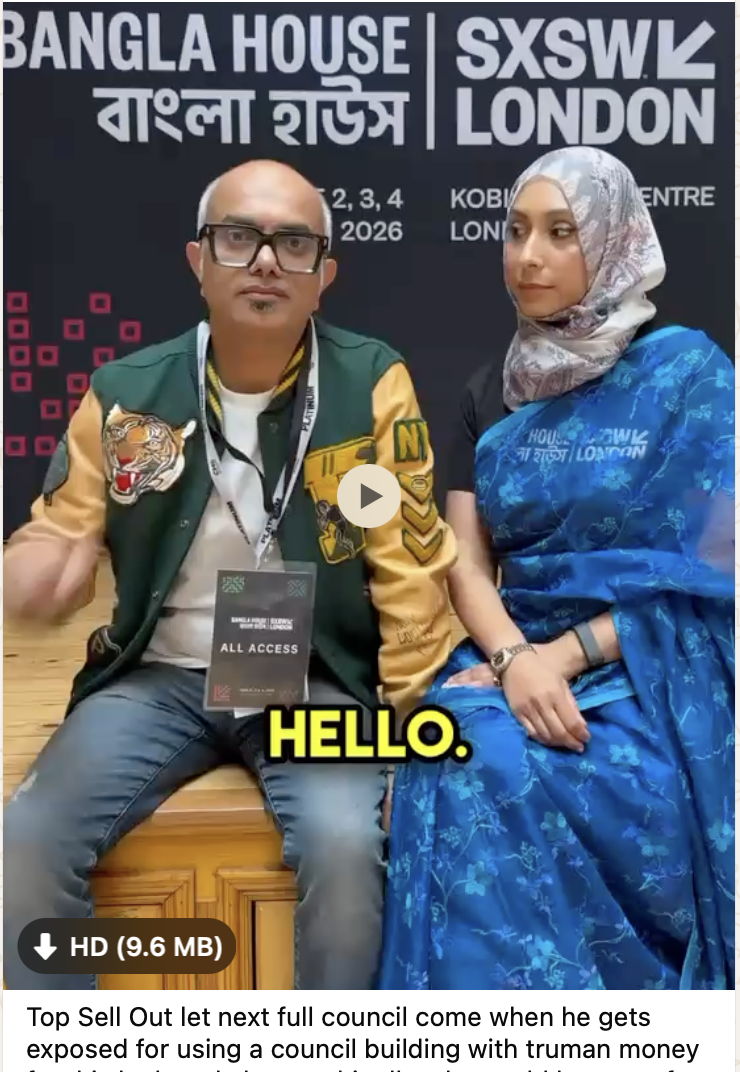
SXSW London, a festival of culture and technology, ran across east London from 1 to 6 June 2026. The Kobi Nazrul Centre was one of its venues. From 2 to 4 June it hosted “Bangla House”, a programme of talks and music by Bangladeshi artists, run by BBPI with SXSW London.
The objection is to the festival the building was lent to, and to who pays for it.
Who Pays
SXSW London’s website names one “Super Partner”, its top sponsor: Waymo, the self-driving car company. Waymo is owned by Alphabet, Google’s parent company.
In June 2025, Francesca Albanese, the UN’s Special Rapporteur on the occupied Palestinian territories, reported to the UN Human Rights Council. She named dozens of companies that, in her view, profit from and sustain Israel’s occupation and its war in Gaza. Alphabet is one.
Her report singles out Project Nimbus, a $1.2 billion deal Israel struck with Google and Amazon in 2021 for cloud computing and artificial intelligence. She says the two firms supplied vital capacity to the Israeli army.
Google’s own staff protested against the deal for years. Google sacked about 50 of them after sit-ins at its offices.
The wider picture is grave:
- In January 2024 the International Court of Justice found it plausible that Israel’s acts in Gaza fell under the Genocide Convention, and ordered it to prevent genocide.
- In September 2025 a UN Commission of Inquiry found that Israel had committed genocide.
- Amnesty International and Human Rights Watch have reached similar findings.
Not The First Time
In 2024, more than 80 artists and speakers pulled out of SXSW in Texas because the US Army and arms makers, including RTX (formerly Raytheon), sponsored it. SXSW then threatened legal action against the Austin for Palestine Coalition over cartoons mocking those sponsors. The Electronic Frontier Foundation, a digital rights group, said the threat had no legal basis. SXSW later dropped the Army and arms makers as sponsors.
The London festival has had its own rows. In 2025, artists withdrew when they learned that Tony Blair. There was an advertised session with an executive from Palantir, a surveillance software firm.
What The Law Asks Of The Council

This is not just a matter of politics or taste. The law places a duty on the council.
The Equality Duty
Section 149 of the Equality Act 2010 sets out the Public Sector Equality Duty. Whenever a public body acts, it must have “due regard” to the need to:
- end unlawful discrimination, harassment and victimisation;
- advance equal opportunities for people who share a protected characteristic; and
- foster good relations between groups, by tackling prejudice and building understanding.
“Due regard” means the council must think about these aims properly, and before it decides, not afterwards. The Equality and Human Rights Commission, drawing on court rulings, says the duty is not a box-ticking exercise. Those who decide must know about it. They must apply it with rigour and an open mind. They cannot pass it to someone else. And it does not end once the decision is made.
The duty covers everything a council does, including how it lets its own buildings. It is also proportionate: the greater the likely effect on a group, the more care the council must take.
Protected Characteristics
The Act lists nine protected characteristics: age, disability, gender reassignment, marriage and civil partnership, pregnancy and maternity, race, religion or belief, sex, and sexual orientation.
Two matter here. Race includes nationality and ethnic or national origins, so it covers Palestinians and Bangladeshis alike. Religion or belief covers Muslims. The Kobi Nazrul Centre exists to serve a community defined by both.
Equality Impact Assessments
How does a council show it has had due regard? Usually by writing an equality impact assessment: a record of who a decision will affect, how, and what the council will do about any harm.
English law does not insist on any particular method. The Equality and Human Rights Commission notes that formal assessments stopped being a legal requirement in England in 2011. But weighing the likely effect before deciding is still the main way a council can prove it met the duty. Without a record, it will struggle to defend itself if challenged. That is why the Commission’s framework for councillors treats these assessments as central, and why most councils build them into their decision-making.
A good assessment asks four questions:
- Who is affected, and which protected characteristics do they share?
- Could the decision harm them, or harm relations between groups?
- What evidence do we have, and whom have we asked?
- Can we avoid or reduce the harm? If not, why go ahead?
The petition asks the council to show it asked them.
Why An Adopted Definition Matters
Any equality assessment has a weakness. “Due regard” is broad, and two officers may judge the same facts differently. One sees harmless business; the other sees hostility. An adopted definition closes that gap. It does four things.
- It gives the duty teeth. It turns a general aim, such as fostering good relations, into specific conduct the council has promised to look for. Officers have a written standard to test against, not a hunch.
- It makes the process open. The definition is public. You can read it, see what the council has promised to watch for, and ask whether it did.
- It keeps judgements fair and consistent. The same yardstick applies to every decision, whoever takes it. That protects the council from charges of favouritism as much as it protects residents.
- It makes the council answerable. Once adopted, a definition is something the council must take into account. If an assessment ignores it, councillors, auditors, the Local Government Ombudsman and, in the end, the courts can ask why.
The government uses definitions the same way. In March 2026 it adopted a non-statutory definition of anti-Muslim hostility and compared it to the antisemitism definition it adopted in 2016. It said it would use the new definition when making policy, and urged others to do the same. Neither definition is law. Both are meant to help public bodies apply the law they already have.
The Council’s Own Definition

Tower Hamlets went further than most. In March 2019 it became only the second council in the country, after Newham, to adopt the Islamophobia definition written by the All-Party Parliamentary Group on British Muslims. It calls Islamophobia “a type of racism that targets expressions of Muslimness or perceived Muslimness”.
The definition gives examples. One is denying Muslim peoples the right to govern themselves: for instance, by calling an independent Palestine a terrorist project.
The council also follows the rule set by the Stephen Lawrence inquiry: an incident is racist if the victim, or anyone else, sees it as racist.
Put these together, and the campaigners’ case is plain. A council building hosted an event whose top sponsor is owned by a company the UN says helps deny Palestinians their freedom. Local people see that as racist towards Palestinians and towards the Bangladeshi community whose culture the building is stated to platform. Under its own rules, the council should record the complaint and investigate. Under the Equality Act, it should be able to show it weighed these effects before it agreed the booking.
The Complaint And The Petition
Before the festival opened, residents sent a formal complaint to the council and to local councillors. They asked the council to suspend the booking, treat the matter as a racist incident, and say in writing what it would do.
The events went ahead. Since then, the petition has gathered enough signatures to be heard at full council.
The petition asks the council six questions:
- Who approved the arrangement?
- What checks did the council make first? Did it carry out an equality impact assessment?
- Did anyone tell councillors about SXSW’s sponsors and its record on Palestine?
- Did anyone consider the Islamophobia definition, or the council’s duties under the Equality Act?
- Whom did the council consult: local artists, Bengali groups, Palestine solidarity groups?
- How does this fit with the council’s votes, in January 2025 and July 2026, to pull its pension money out of arms firms and companies that break international law?
It also asks the council to review any further dealings with SXSW, publish every agreement and decision record, and set clear ethical rules for the use of its venues.
If an equality impact assessment exists, the council should publish it. If not, it should say so, and explain how else it had due regard.
The Other Side
People such as Abdal, the local Labour Party, SXSW, Data Centre Companies, the Truman Brewery etc, may object to the facts stated in the petition. And the council may weigh them. But it must do so in the open, with its reasons and records on the table. A council that has twice voted to take its pension money out of companies linked to Israel’s conduct cannot say that what happens in its own cultural centre is none of its business.
What Next
Tower Hamlets adopted its Islamophobia definition as a matter of principle. The Equality Act makes weighing equality a matter of law. Both are tested when they are inconvenient: when the other side is a famous festival backed by one of the world’s biggest companies, and the accompanying large amounts of money.
On 7 October, we will find out whether the council’s word still holds. And whether actions speak louder than words.

Recent Comments