
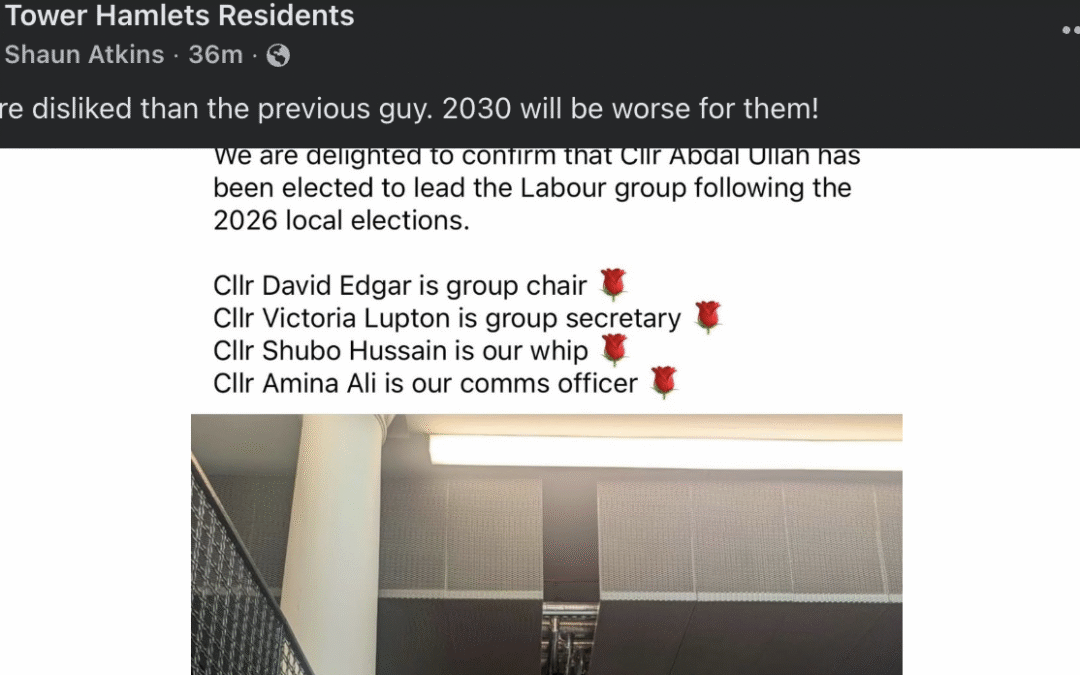
This article is a response to, and critique of, the post-election analysis produced by Andrew Wood.
My central argument is straightforward: the election result in Tower Hamlets was shaped more by class and organisation than by identity politics. National political headwinds mattered far more, amplified by a lack of local narratives by Labour, while both Aspire and the Green Party built functioning ground operations at the very moment when local Labour activists were effectively abandoned by their national party.
Andrew and I: The Odd Couple of Tower Hamlets Politics
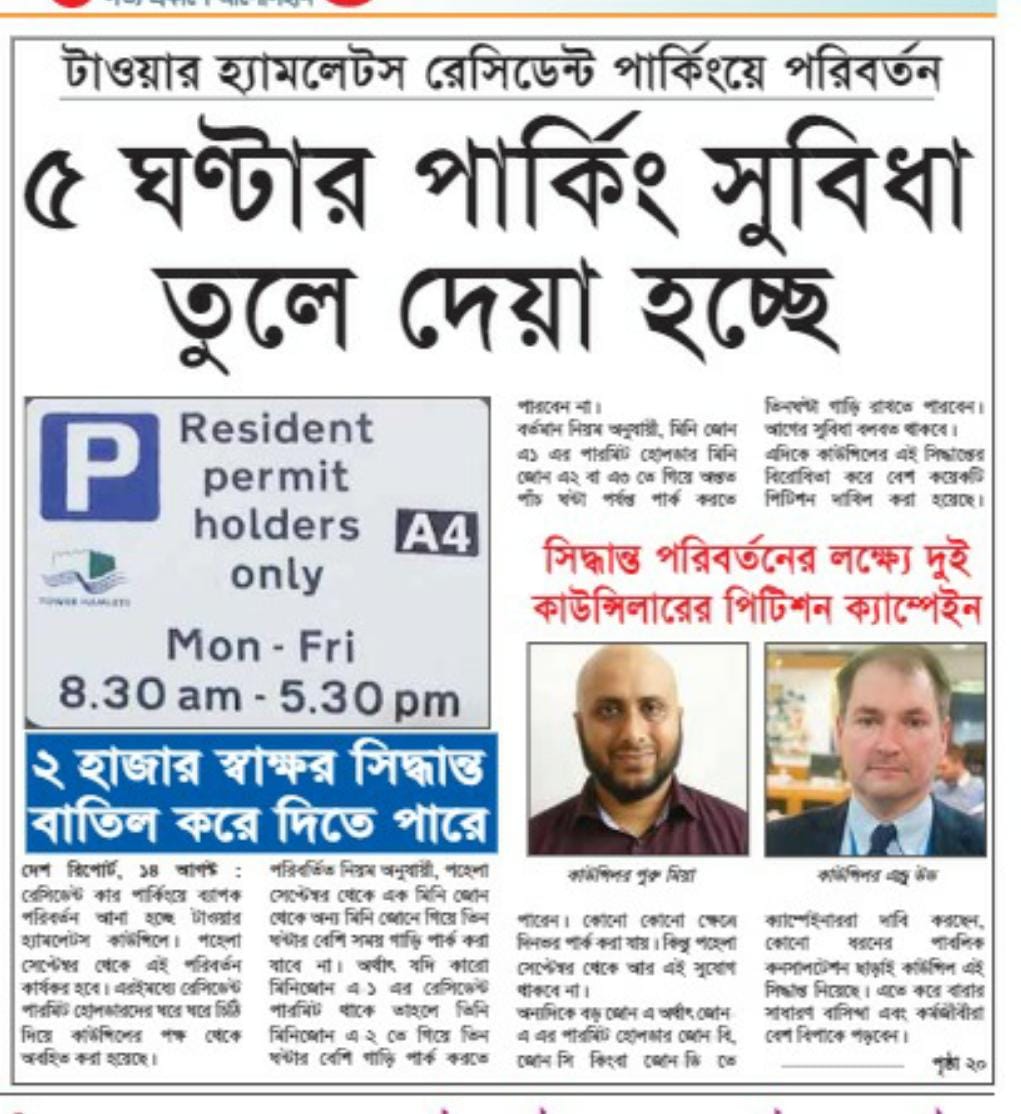
Before addressing the substance of the election, some context is necessary. I consider Andrew a friend. During our time as councillors, we worked together on a range of campaigns, including those relating to Shamima Begum, parking policy, and Low Traffic Neighbourhoods. In practical political terms, I learnt more from Andrew’s mentorship than from the combined efforts of many other Labour councillors I encountered.
That does not mean we agree politically. Our most obvious disagreement concerns Palestine, though there are broader differences of political outlook as well. The historian and philosopher Ibn Khaldun argued that people are shaped by their social and historical environments. That observation remains relevant in modern local politics: individuals approach political questions through the prism of their experiences, class position, and communities.
Yet disagreement need not preclude cooperation. In a functioning civic culture, political opponents should still be capable of working together on shared concerns: competent public services, safe neighbourhoods, reliable infrastructure, and accountability in local government. Those are goals that transcend factional politics.
It is precisely because I take local politics seriously that I disagree with Andrew’s analysis of the 7 May 2026 election.
Class, Not Identity, Remains the Primary Electoral Divide
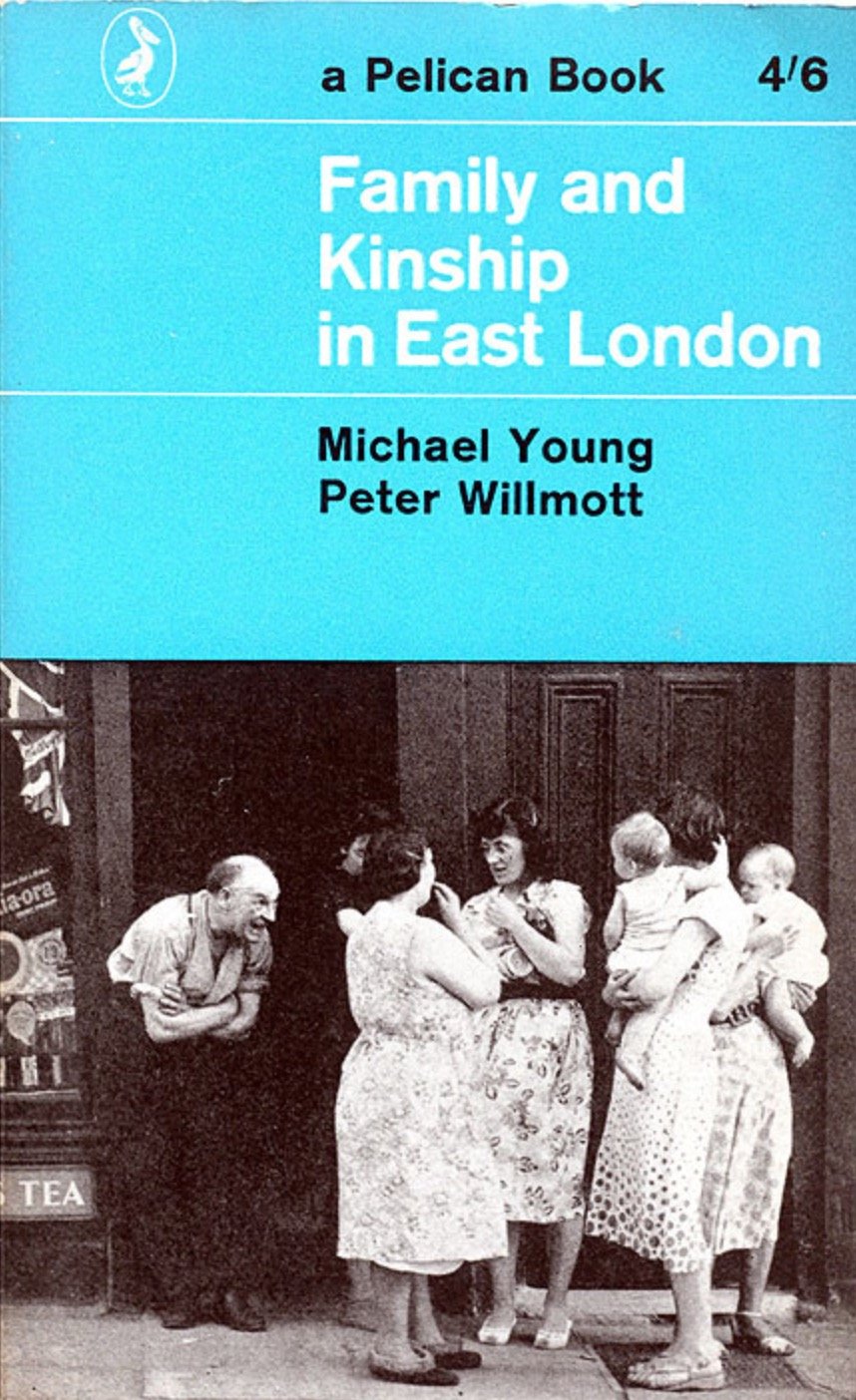
One of the most misunderstood features of politics in Tower Hamlets is the composition of the electorate itself.
Roughly a third of the borough’s population changes address each year, reflecting the transient nature of life in inner London. This includes short-term renters, students, migrant workers, and young professionals. Many of these residents are registered to vote, but registration alone does not translate into participation in local elections. For large sections of this group, registration is either incidental to national elections or simply a bureaucratic necessity linked to credit checks and tenancy arrangements.
The deeper issue is precarity. Constant mobility discourages the formation of long-term attachments to neighbourhoods or local institutions. Residents who do not expect to remain in an area for long rarely develop a sustained interest in its civic politics. This is one reason Labour campaigns in inner London boroughs have historically relied on short, centralised election operations rather than continuous community organising.
Testing the Thesis: There Once Was a Yorkshireman

Copyright 2008 BBC
An encounter I had last year illustrated this dynamic clearly. While travelling in the Gulf on business, I met a young commercial lawyer originally from West Yorkshire who had previously rented in the Brick Lane area. He recognised my “Save Brick Lane” badge on my business suit and struck up a conversation about the campaign against the redevelopment of Truman Brewery.
Over dinner, I asked whether he had ever voted or participated in local politics in Tower Hamlets. His answer was no. Although he identified culturally as Bangladeshi, his relationship with the borough was fundamentally transactional and temporary. London was a staging post in a professional career that had already taken him abroad.
This matters because it undermines the simplistic claim that Aspire’s success can be reduced to ethnic bloc voting. The borough’s reliable local electorate is disproportionately composed of social housing tenants and owner-occupiers, residents with long-term material stakes in the area. Aspire’s base is therefore better understood as a working-class coalition, the majority of whom happen to be Bangladeshi, rather than a purely ethnic voting bloc.
The 2022 elections demonstrated this clearly. Aspire successfully built a broader, multi-ethnic coalition by opposing Low Traffic Neighbourhoods and related policies that many residents perceived as dismissive of working-class concerns. The 2026 results suggest that the coalition has largely held.
Organisation Matters More Than Messaging: Labour Apathy vs Aspire and Green Energy
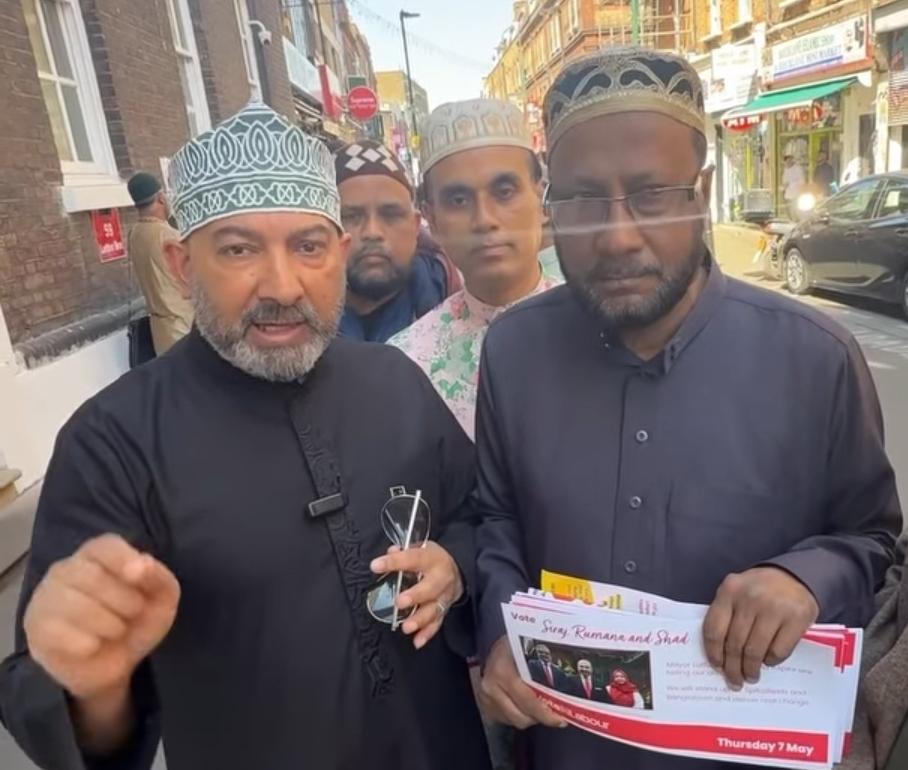
Communities do not mobilise themselves. Elections are won through organisation.
Both Aspire and the Greens understood this. Labour, in Tower Hamlets, did not.
There is an old military adage: amateurs discuss tactics and strategy; professionals discuss logistics. The same principle applies to political campaigns.
For years, the local Labour Party has operated from a position of institutional mistrust toward its own working-class membership base. That culture is partly rooted in the borough’s political history, where defections between Labour, the Liberal Democrats, Respect, and Aspire created a persistent sense of insecurity within Labour’s internal structures.
The consequence has been chronic dependence on intervention from Labour headquarters: parachuted organisers, centrally directed messaging, and campaign operations imported from outside the borough. Instead of developing durable local capacity rooted in working-class activists familiar with the area, the party repeatedly relied on rescue operations from the centre.
That model collapsed in 2026.
Local Labour campaign literature continued to lean heavily on the national Labour brand at precisely the moment when the national party had become electorally toxic in many working-class urban areas. Rather than adapting messaging to local conditions, Labour distributed generic material seemingly designed for a different electorate altogether.

By the time Sirajul Islam was selected, much of the national party had already written off the borough. As Labour struggled to defend councils elsewhere in London, resources were redirected toward areas deemed salvageable. Candidate selection in Tower Hamlets lagged because the borough was no longer treated as a strategic priority.
The contrast with the Greens and Aspire was stark.
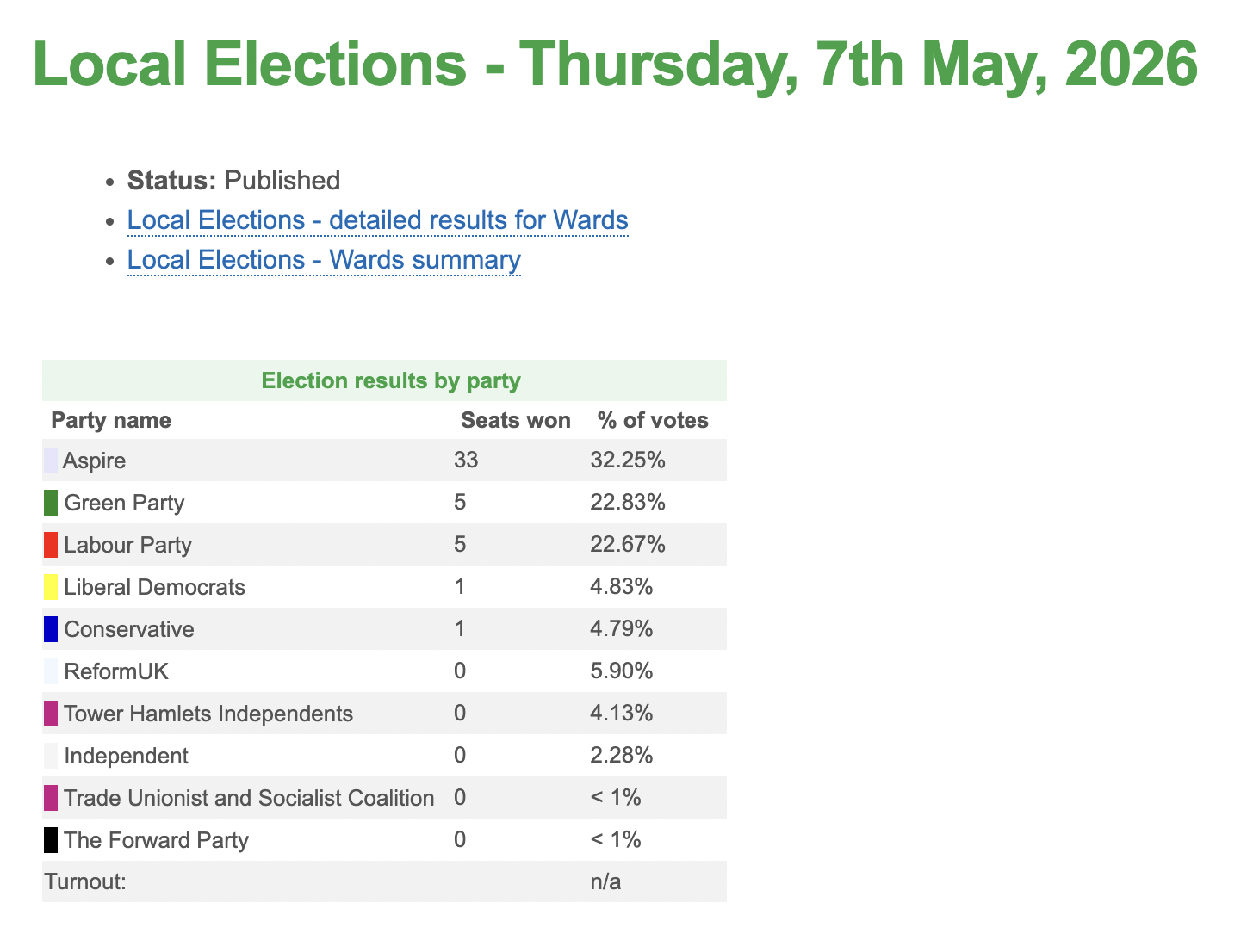
The Greens identified target wards using data from the 2024 general election and concentrated their limited resources efficiently. In several areas, they either won outright or emerged as close challengers.
Aspire, meanwhile, pursued a broader and more disciplined long-term operation. Canvassing began in earnest in the autumn following the 2024 general election. Councillors and candidates campaigned collectively on weekends under a tightly managed operation designed to maximise visibility and reinforce party cohesion.
Labour simply did not match that level of organisational seriousness.
Labour’s Crisis of Credibility: NPC Abdal Ullah (Non Playable Character)
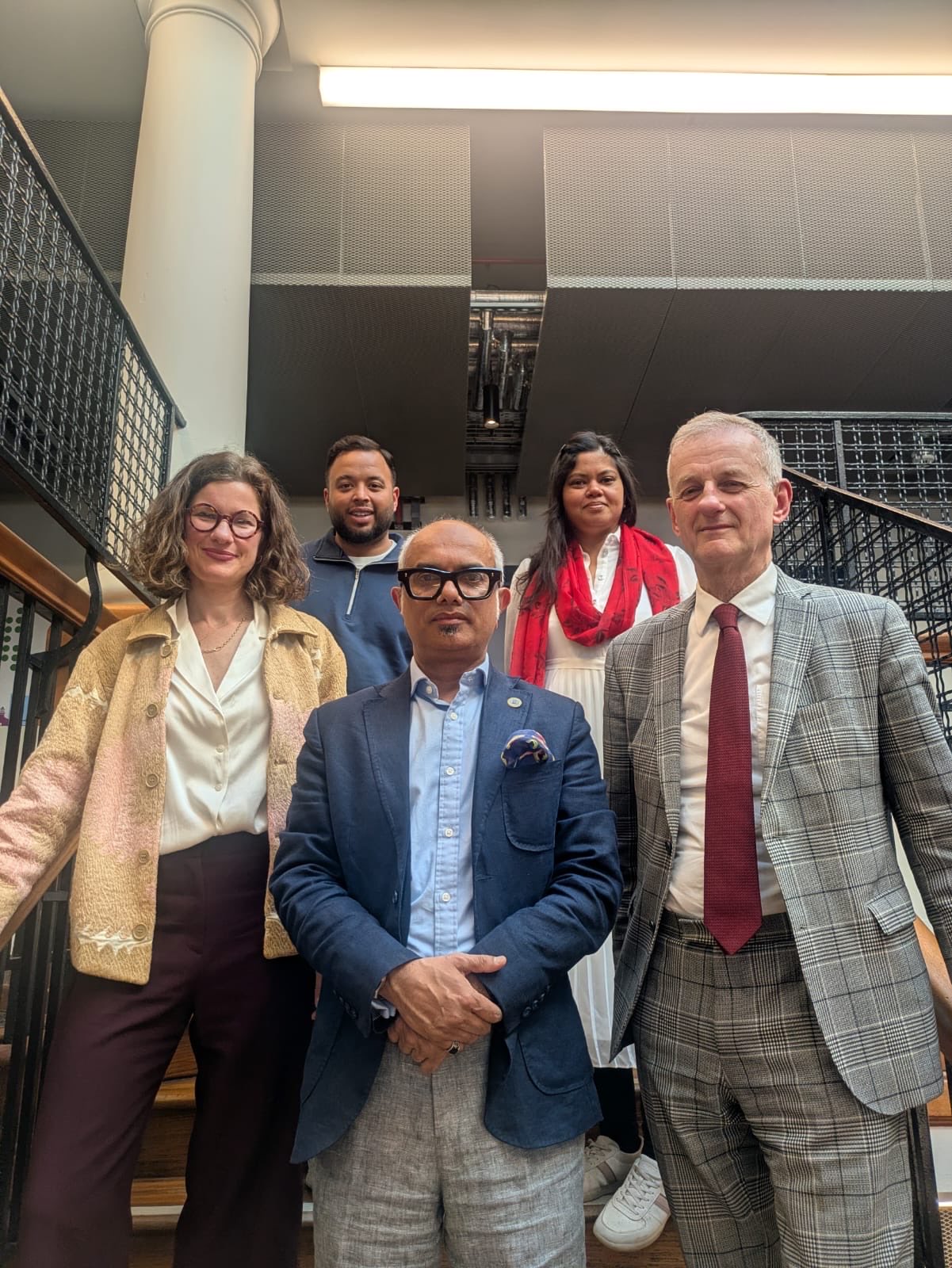
Instead of conducting a serious post-mortem after defeat, sections of the local Labour Party moved rapidly into internal leadership manoeuvring.
The elevation of Abdal Ullah has reinforced the perception among many residents that Labour remains disconnected from the borough’s wider electorate. Fairly or unfairly, he is viewed by critics as emblematic of the landlordism, internal arrogance, and political insularity that have weakened Labour locally for years.
This has led to increasingly open speculation about whether Labour is capable of rebuilding at all in Tower Hamlets. Some even question whether Aspire allowed Abdal to win, as as to strategically benefit from a weak Labour Group Leader, more unpopular than Siraj.
Andrew’s analysis appears to assume that Labour remains the natural alternative government in the borough. That assumption now looks increasingly outdated.
The more realistic picture is of a fragmented post-Labour political landscape. Aspire dominates large sections of the working-class vote; the Greens are consolidating among younger progressive professionals; and there may still be opportunities for the Liberal Democrats and the Conservative Party in the more affluent riverside wards, provided they run disciplined and locally rooted campaigns.
The era in which Labour could rely on historical loyalty and institutional inertia in Tower Hamlets may well be over.
Yesterday, upon the stair,
I met a man who wasn’t there.
He wasn’t there again today,
I wish, I wish he’d go away!
Antigonish – by William Hughe Mearns
Insightful and thought-provoking analysis on the changing political landscape in Tower Hamlets. A very engaging read.
There are other reasons labour failed
The national anger against Labour
Muslim organisations like 5pillars supporting aspire party for all the wrong reasons
Tablighi jammat and other muslim groups supporting aspire
Italian bengali who are known to be frauds supporting aspire party
Other European bengali supporting aspire party
The sylhety community had a big split especially between labour aspire green independents party
Reform created the split in the white community giving the racists especially a new alternative to vote for
Interesting analysis. Aptly analysed, as always. Would be great to see similar analysis for Newham borough, what happened there. I suppose, London’s Tower Hamlets borough residents and stakeholders have some organisational unity (or at least joint grassroots coordination) compared to the more diverse yet divided and fragmented communities in the Newham borough (where Labour mayor won).